Being honest, we have all been sitting in front of a computer at 2 PM on a Tuesday, and then watched our own productivity melt away like sugar in hot coffee. You’re not tired. You slept fine. But there is something not firing up the staircase. This is where nootropics come into the picture. What Are Nootropics.
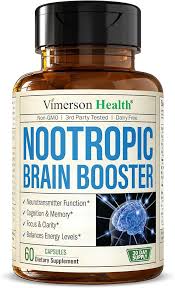
Nootropics are compounds (synthetic, natural, or both) that purport to enhance cognitive ability. Memory. Focus. Mental clarity. Even mood. The term was coined in 1972 by Romanian psychologist Corneliu Giurgea, who thought that a true nootropic must both improve learning and protect the brain. A high bar. It is not cleared out clean by most things on the market today, but that has not been snarling anybody up.
The market is huge. It is estimated to be over 5 billion dollars worldwide and it is rapidly growing, as students spend all-nights at school, executives strive to achieve optimal performance, and aging adults seek to maintain their mental advantage deep into their late 70s. Various individuals, identical lust: a keener intellect.
So what happens to be effective?
The obvious place to start is caffeine. Combined with L-theanine, an amino acid that is naturally present in green tea, it turns into something more interesting. The theanine calms the jittery advantage of caffeine. You have alertness and none of the anxiety spiral. There is a lot of research behind this combo. It is not glamorous yet it will work.
The same cannot be said about racetams. The first synthetic nootropic, piracetam, has been researched since the 1960s. Users have reported a better verbal recall and more focus. It is mixed science at best, and the anecdotal following is huge. Consider a drug that has millions of fanatical users and scientists still debating the mechanism. Piracetam in a nutshell.
Then there are the adaptogen crowd. Ashwagandha (Lion’s mane mushroom), bacopa monnieri. They have long been a part of Ayurvedic and traditional Chinese medicine. The mane of the lion, in particular, has come of serious scientific interest, some studies suggesting it may stimulate Nerve Growth Factor (NGF), which is of tremendous importance to neuroplasticity. Your brain actually expanding to new connections. It is not marketing hype, it is real biology, although larger human trials are still playing catch-up.
Modafinil receives independent category. Initially created to treat narcolepsy, it gained infamy as a so-called smart drug after users realized that it could keep them awake and focused up to 12+ hours without the same crashing effect as stimulants. Prescription-only in most countries but that has not deterred a grey market that is flourishing. Ask any medical student in his finals week – someone always knows someone.
Here’s what people get wrong
The greatest error is to use nootropics as a magic button. They’re not. One of my colleagues told me that she began taking a pile of five various supplements hoping that she would feel just like Bradley Cooper in the film Limitless. After three weeks, she was not able to tell whether anything was different. I suppose my baseline has simply improved? she said half-jokingly.
That’s the problem. Cognitive improvement is sluggish, delicate and very intimate. Genetics, quality of sleep, diet, baseline stress – all of it alters the responses of your brain to any particular compound. What makes one man a narrowed-eyed machine, leaves the other one perfectly flattened.
Dosage matters enormously. More is virtually never better with nootropics. An overdose of racetams, such as, may produce brain fog – the very last thing that you want. That is the type of irony that burns.
The stacking trap
Stacking (also known as stacking nootropic) refers to the process of using several nootropics at once in order to maximize their effects. Certain combinations are well-documented. Others are individuals who confuse stuff as a forum post indicated so. It has some cowboy logic to it – toss enough stuff at the wall, and see what sticks.
The issue? When something gets off track, you never know which of the ingredients made it go. It is like a recipe troubleshoot when you have altered a hundred and fifty things simultaneously.
Begin with a single compound. Put it to the test–at least four or six weeks. Track your baseline. Keep notes. Cheesy suggestions, yes, but it will help to distinguish actual statistics and placebo-powered optimism.
The ethical undercurrent
A new debate is being raised concerning cognitive improvement and justice. When a student uses modafinil in exams, does he cheat? Scholars are really split. Others liken it to coffee. Others see a slippery slope to performance pressure that normalizes pharmaceutical shortcuts.
These aren’t easy questions. And they increase in hardness as the compounds increase in effect.
In the meantime, nootropics have an intriguing grey area, neither medicine nor wellness. In between a morning espresso and a prescription pad. The science is slowly catching up the hype. There are things that will be proved true. Many will not.
However, when you make your brain the costliest item of hardware you possess, the urge to maximize it isn’t insane. It’s just human.